- The verdict
- What is on hand, what is missing
- The four tabs and who wrote them
- Bars 1 to 10 are not a drum part
- Where the transcriptions disagree
- The timing map and its two failures
- The human transcription on hand
- What the drive unlocks
- The stems and their clock
- The editing copy
- The rebuilt drum part
- Evidence ledger
01The verdict
Three premises in the brief did not survive contact with the disk.
Stems, in /Users/Shared
1596 kHz, 24 bit, 213.752 s. Six piece drum split plus a metronome track. Found only after Brandon asked whether the shared folder had been checked.
Donor picked by favorites
229s642618 by David-129 holds 229 favorites against 55, 9 and 1 for the others. It was exported and is now the base for the editing copy.
Human drum notation on hand
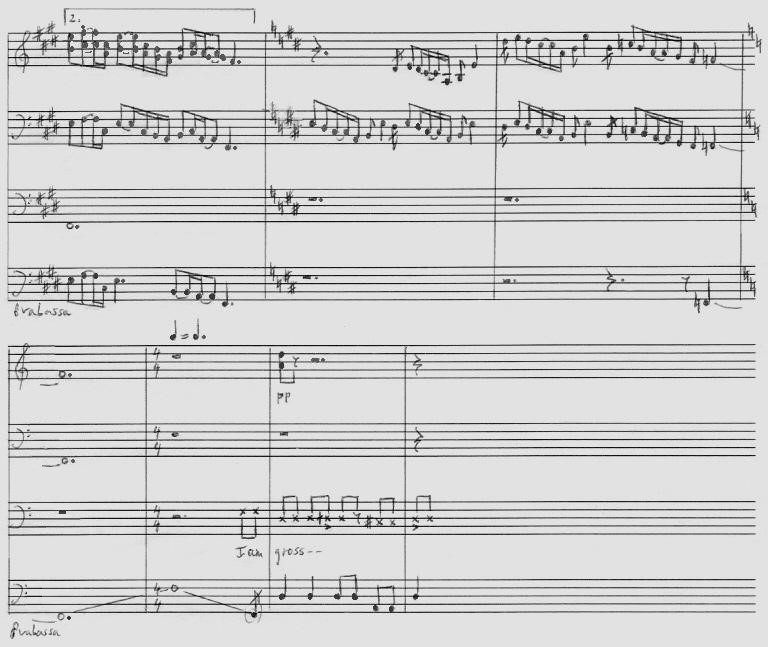
1Kasper Sloots wrote a four staff score of the opening with a percussion staff at the verse entry. It covers the first pages of the song.
Measured tempo, mean
87.2Beats per minute across 77 bars, drifting between 81.1 and 94.5. Every tab ships a 120 then 90 map instead, which is a generator default.
Correction, and where the first pass went wrong
The first version of this page reported the stems unreachable, on the strength of a volume list showing only Macintosh HD. That search covered Projects, Music, the Desktop anchors and the external drives. It never touched /Users/Shared, which is where a complete fifteen stem Moises Pro separation of this song was sitting the whole time. Two other Zappa songs, Keep It Greasey and Watermelon In Easter Hay, keep their stems in the same folder. Search that path first on any Zappa audio question.
One published claim is also withdrawn. The first pass called the solo entry a fourteen second failure, comparing a tab clock reading of 2:28 against the Sloots timestamp of 2:42. The lead stem puts the solo entry at 2:33, in audio bar 56. The Sloots 2:42 is a clip start inside the solo rather than its first bar, so the real gap is five seconds and the overstatement was mine.
What this changes about the assignment
The brief treats I'm The Slime as a ghost note repair with good stems, our own Guitar Pro, and human transcriptions in hand. The song is not in the 34 id program register, holds no pre-sweep baseline on disk, and has no restore in the moderation queue. It was never touched by the ghost sweep. This is a new transcription from a blank start, and the ghost note repair workflow does not apply to it.
02What is on hand, what is missing
| Source class | Status | Where it is, or why it is not |
|---|---|---|
| Dedicated Moises Pro stems | 15 stems | /Users/Shared/Frank Zappa - 02 - I’m the Slime-F# minor-87bpm-443hz/ — kick, snare, toms, hat, cymbals, other_kit, bass, lead, rhythm, piano, wind, other, vocals, backing_vocals, metronome. 96 kHz, 24 bit, 213.752 s each. |
| Our own Guitar Pro file | built now | None existed. The donor was exported from s642618 and rebuilt with the measured tempo map at _outputs/zappa-slime-transcription/gp/. |
| Songsterr tabs | 4 pulled | All four saved to _outputs/zappa-slime-transcription/tabs/ with full track JSON for every instrument. |
| Kasper Sloots score | opening only | Three scans plus prose at _outputs/zappa-drum-sources/08-analysis/zappa-analysis/. Percussion staff visible at the meter change. |
| Paul Pappas, Hal Leonard 2011 | not held | Sloots records that Pappas transcribed the song in full for the Hal Leonard guitar songbook series. That book is copyrighted and is not on this Mac. |
| Our Over-Nite Sensation band book | not evidence | drwu-overflow/bandbooks-library/zappa-overnite.pdf, pages 9 to 12. Its section map lists round timestamps at thirty second spacing, which is template filler. Its key and tempo claim conflicts with Sloots on the opening. |
| Program register entry | absent | I'm The Slime is not among the 34 song ids on the Zappa program scope page. |
03The four tabs and who wrote them
Authorship was read from the Songsterr meta endpoint on 2026-09-07.
| Song id | Title | Author | Made via | Created | Views | Bars | Drum notes |
|---|---|---|---|---|---|---|---|
| s642618 | I'm The Slime Frank Zappa | David-129 | Editor | 2026-08-02 | 7,768 | 80 | 1354 |
| s4663113 | I'm The Slime 1 Frank Zappa | nick3388 | AI | 2026-04-04 | 46 | 81 | 1532 |
| s2826582 | I'm The Slime Frank Zappa, The Mothers Of Invention | Aaron-Albrecht | AI | 2025-11-06 | 963 | 81 | 1510 |
| s6070985 | I'm The Slime Frank Zappa, The Mothers | Joshua-Rendall | AI | 2026-07-16 | 0 | 81 | 306 |
None of these is ours, so none of them can take a revision
The standing rule is that we revise our own tabs only, and that any rebuild goes into a copy we own rather than into somebody else's file. Three of the four carry the AI generated flag set by their own authors. The fourth was built in the editor by David-129 and has 7,768 views. Work on this song starts with Create a copy to edit, on whichever tab we choose as the donor.
04Bars 1 to 10 are not a drum part
Every one of the four tabs writes the opening the same way. Bar 2 through bar 10 hold sixteen sixteenth notes per bar, each one a kick and a crash struck together, with no tuplet and no rest. The tempo automation puts those bars at 120 beats per minute. That is eight kick strokes and eight crash strokes every second, held for nine straight bars.
The raw beat, copied out of the tab JSON
duration [1,16] tuplet none rest none notes [(36 kick, 3.5), (49 crash, -1)]
That line repeats sixteen times inside bar 2, and again inside bars 3, 4, 5, 7, 8, 9 and 10. The pattern is a rhythm doubling of the opening guitar riff written onto the drum staff. No drummer plays it and no listener hears it on the record.
David-129 thinned the crash to four strikes per bar across bars 6 to 9 and added a single snare on beat three of each. The sixteen note kick line survives untouched in all four tabs. The repair for this passage is a rewrite from the audio, and no ghost note pass reaches it.
Sloots reads the same passage in 12/8
The Sloots prose says the song uses 12/8 and 4/4 as meters, with four groups of three becoming four groups of two at the change. Every tab is in 4/4 from bar 1 with no signature change anywhere. Sloots notes that Paul Pappas made the same choice in the Hal Leonard book, writing 4/4 with triplets throughout. Writing 4/4 is a defensible notation of the passage. Writing straight sixteenths on a kick and crash unison is a separate problem.
05Where the transcriptions disagree
Onsets per lane across the whole song, counted from each tab's own drum track.
| Lane | David-129 | nick3388 | Aaron-Albrecht | Joshua-Rendall | Spread |
|---|---|---|---|---|---|
| Kick | 406 | 450 | 441 | 145 | |
| Snare | 274 | 346 | 340 | 5 | |
| Hi-hat closed | 144 | 187 | 231 | 0 | |
| Hi-hat open | 8 | 51 | 50 | 0 | |
| Floor tom | 33 | 0 | 0 | 0 | |
| Low tom | 0 | 19 | 21 | 0 | |
| Mid tom | 112 | 61 | 61 | 0 | |
| Ride | 218 | 188 | 154 | 0 | |
| Crash | 157 | 228 | 210 | 85 |
The tom lanes never agree
David-129 puts fills on a floor tom and a mid tom, and writes nothing on the low tom. Both machine tabs write a low tom and a mid tom, and write nothing on the floor tom. The bar lists barely overlap.
| Lane | David-129 writes it in these bars | nick3388 writes it in these bars |
|---|---|---|
| Floor tom | 14, 22, 52, 54, 74, 76, 80 | none |
| Low tom | none | 18, 20, 39, 43, 55, 75, 77, 80 |
| Mid tom | 14, 16, 17, 18, 19, 20, 21, 22, 38, 42, 46, 47, 48, 49, 50, 52, 53, 54, 66, 74, 76, 79 | 15, 17, 18, 19, 20, 39, 43, 47, 51, 53, 54, 55, 75, 77, 80 |
Bar 21 is the sharpest case. David-129 writes twenty mid tom strokes there and all three machine tabs write none. A dedicated tom stem settles that bar in one look, and nothing short of a tom stem settles it at all.
One passage, two different cymbals
Bars 57 to 62, SETTLED. It is the ride, and David-129 was right.
Over those bars, audio bars 54 to 59 at 147.55 to 164.11 seconds, the hi-hat stem reads an RMS of 0.000178 against 0.002291 in a mid verse control window. That is 0.08 of its own normal level, which is silence. The cymbal stem over the same bars reads 0.010191 against 0.000078, which is 131 times its control. Per bar the hat runs 0.00006 to 0.00040 while the cymbals run 0.00345 to 0.01517. The author's 218 ride notes stand and nothing was changed.
The dispute as it stood before that measurement:
David-129 writes 44 ride strokes across those six bars and no open hi-hat. nick3388 writes 41 open hi-hat strokes across the same six bars and no ride. The rhythm matches closely and the instrument does not. Under the tab clock those bars run from 2:22.7 to 2:38.7. A separated cymbal stem decides this, and the count based tests cannot, because a ride played in continuous subdivisions hides its own onsets under the decay of the preceding stroke.
Across the whole song there are 205 bar and lane cells where the hand edited tab differs from a figure both machine tabs agree on. Those cells are the review queue for the stem pass.
06The timing map and its two failures
All four tabs carry an identical tempo automation. Bar 1 sits at 120 beats per minute and bar 11 drops to 90, with 4/4 throughout and no further change. That map produces the clock below.
| Bar | BPM | Starts at | What sits there |
|---|---|---|---|
| 1 | 120 | 0:00.00 | Guitar intro, kick and crash saturation begins |
| 11 | 90 | 0:20.00 | Tempo drop, rhythm guitar riff enters |
| 21 | 90 | 0:46.67 | Tom fill disagreement, twenty strokes against zero |
| 50 | 90 | 2:04.00 | Vocal track density rises for the first time |
| 59 | 90 | 2:28.00 | Lead guitar density jumps from 1 to 19, the outro solo |
| 62 | 90 | 2:36.00 | Last bar of the ride against open hi-hat passage |
| 81 | 90 | 3:26.67 | End of the longest tab |
Failure one, WITHDRAWN as written, and restated smaller
This section first read that the solo landed fourteen seconds early, comparing the tab clock's 2:28.0 against the Sloots timestamp of 2:42. The lead stem settles it. The solo enters at 2:33, in audio bar 56. Sloots picked 2:42 as the start of an audio clip inside the solo, so it was never a claim about the first bar. The tab clock is off by five seconds there, not fourteen, and the fourteen was mine.
Failure two, the tab runs short of the record
Eighty one bars under this map fill 209.3 seconds, and eighty bars fill 206.7 seconds. The album take runs 3:34, which is 214 seconds, confirmed against the Wikipedia entry for the song on 2026-09-07. The tab clock is between five and seven seconds short of the record.
Both failures point the same way, and the metronome stem settles both. The 120 then 90 map inherited by all four tabs is a generator default. The record runs 77 bars at a mean 87.2 BPM with real drift between 81.1 and 94.5. That measured map is now written into the editing copy.
07The human transcription on hand
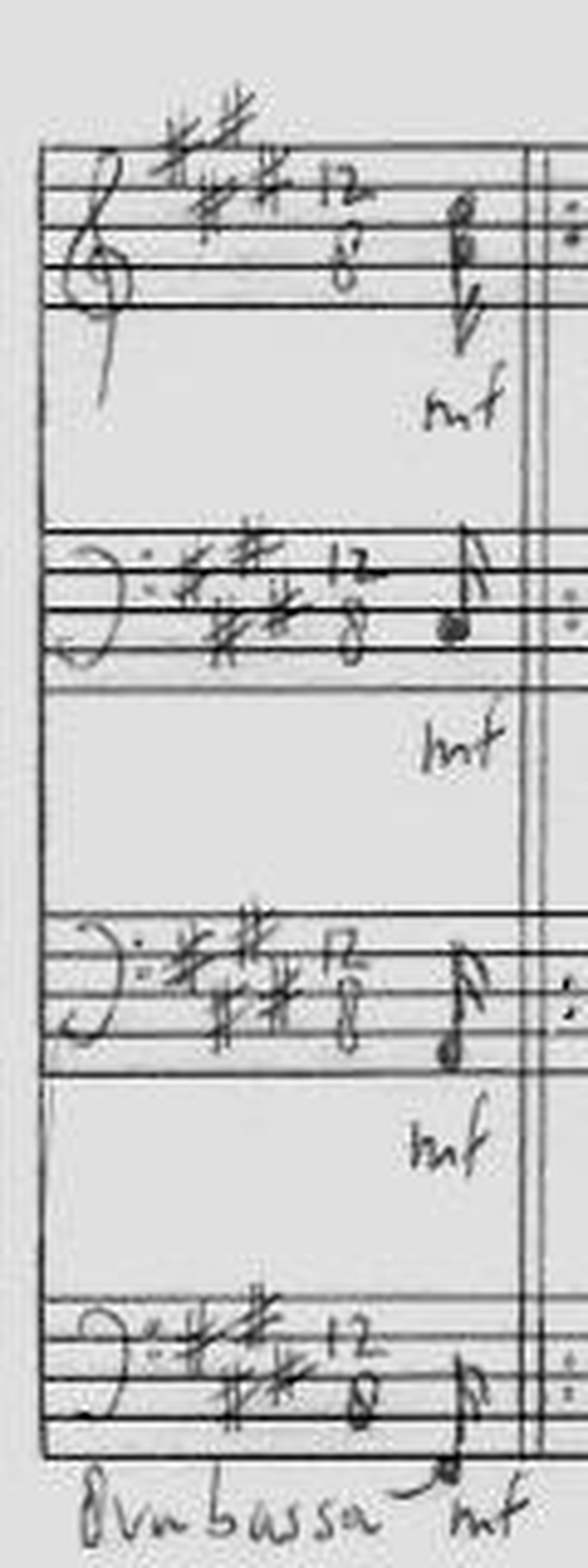
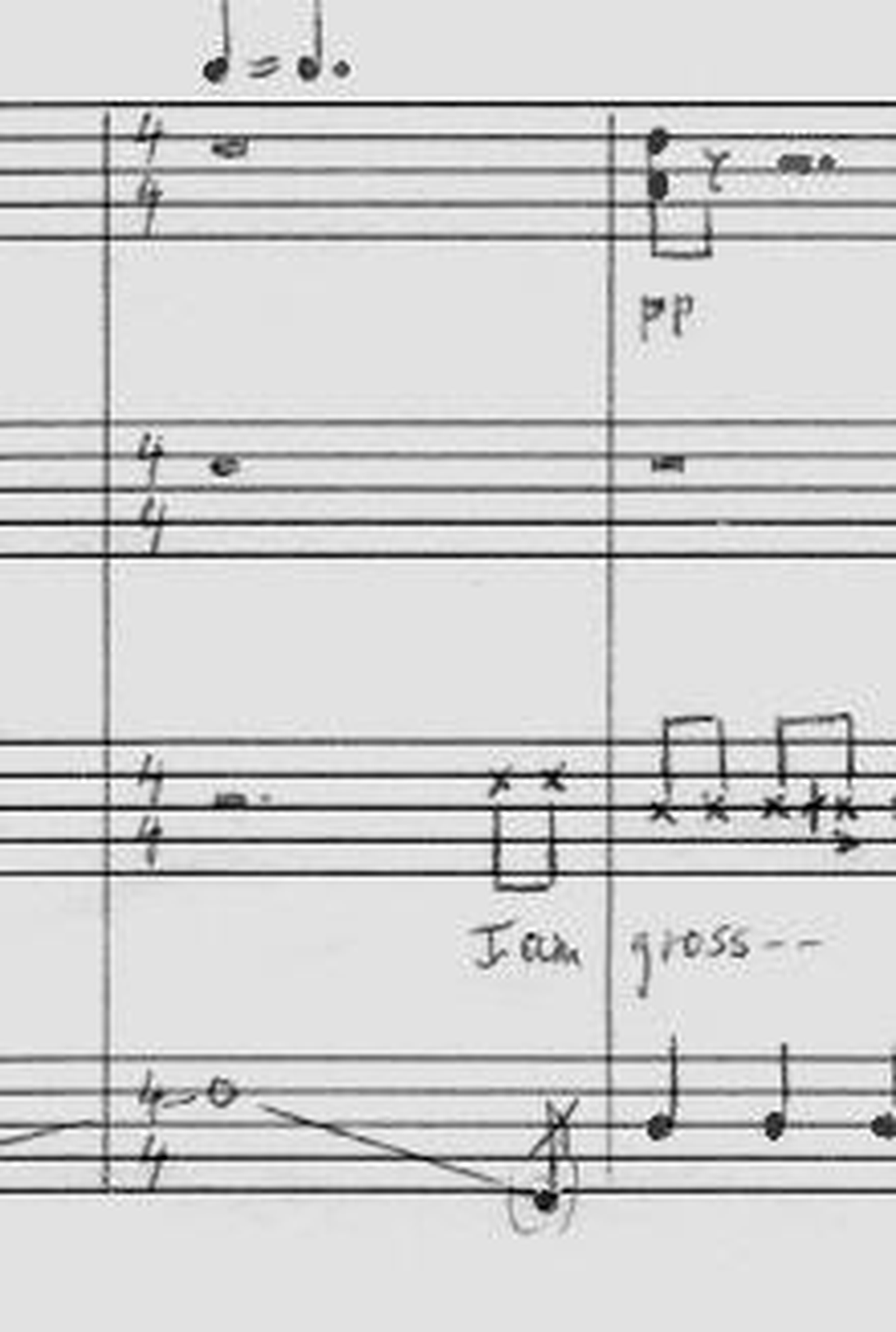
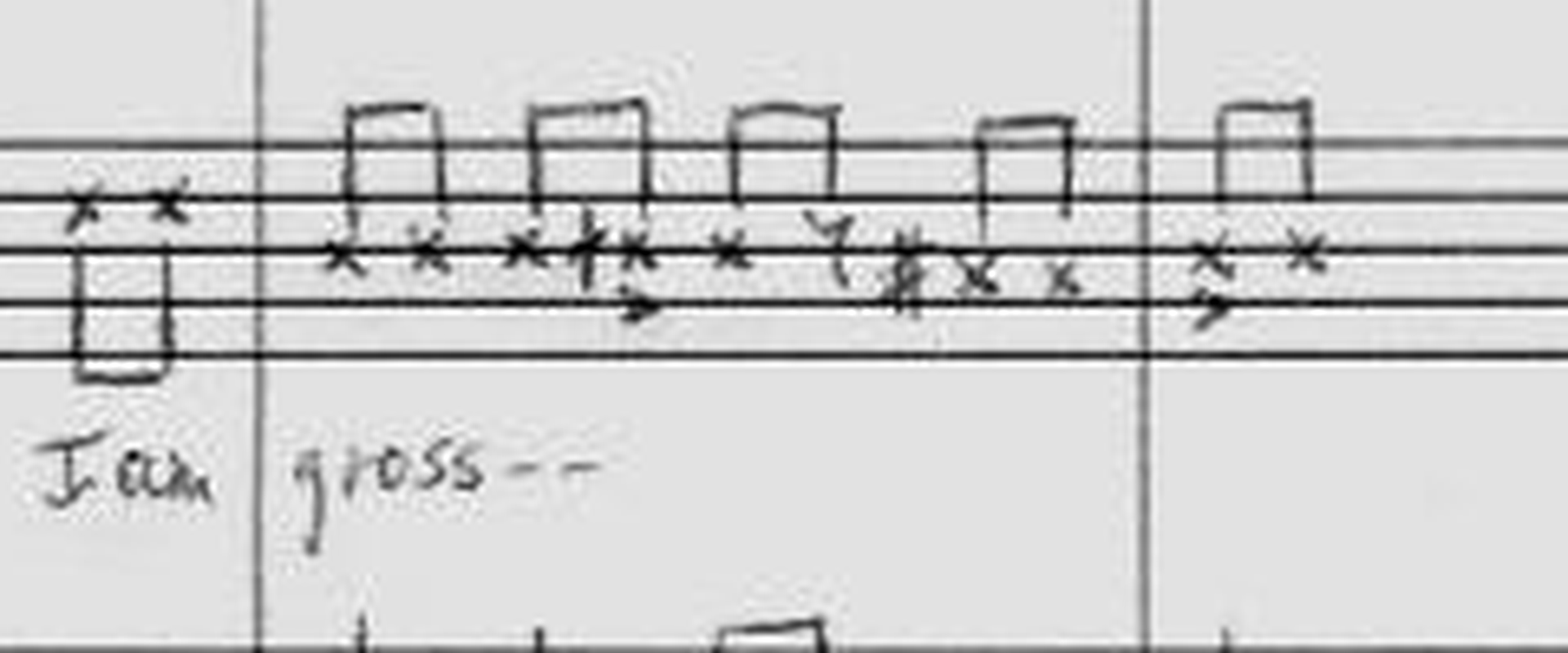
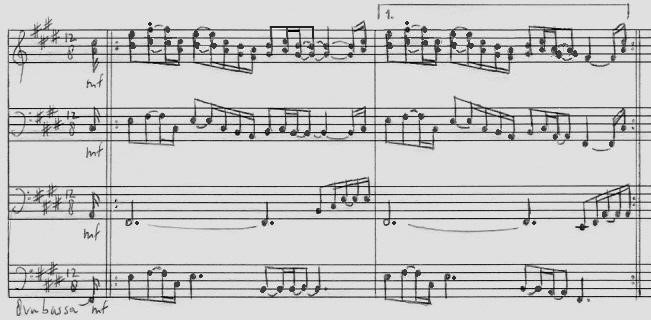
Kasper Sloots wrote a four staff score of the opening. The first scan carries the 12/8 system with the melodic riff, a bass clef inner voice, and a bass guitar staff marked 8va bassa. The second scan carries the meter change, and its third staff switches to percussion notation there. That staff holds the only human drum notation for this song on this Mac.
Three readings were taken off native resolution crops rather than off the page overview, so a handwritten digit could not be misread at reduced scale. All four staves carry 12/8 at the opening. The sharp count is settled below by the bass stem rather than by the scan. The change is to 4/4 on all four staves under a quarter equals dotted quarter equivalence mark, which is the constant beat relation the Sloots prose describes. The percussion entry writes X noteheads at two distinct staff heights with accent marks below several of them, so Sloots notated two cymbal voices rather than one undifferentiated hat line.
The meter glyph holds. The audio test that was supposed to confirm it does not.
Cropping the opening time signature on its own gives 28 by 50 native pixels, and at that size the stacked 1, 2 and 8 are legible. The 12/8 reading stands. The key signature beside it failed the same test at 36 by 54, because three overlapping handwritten sharps need far more resolution than two printed digits.
A test on this page was invalid, and it is withdrawn
What this page said before. A section headed straight versus triplet reported roughly even splits across every passage and every lane, and read that as proof the detector was finding noise.
What is true. The even split was built into the test. A straight grid offers four slots per beat and a triplet grid offers three, so the denser grid always sits closer to any set of points. Measured against uniform random phases, mean deviation runs 0.0622 on the straight grid against 0.0835 on the triplet grid by construction. Comparing the two raw numbers was never a fair contest.
Against their own baselines, the opening reads bass 0.0615 against a 0.0622 chance, kick 0.0507 against 0.0622, and lead 0.0636 against 0.0622. Only the kick beats chance, and modestly. This audio test cannot decide the opening meter. The 12/8 reading rests on the Sloots glyph and his prose, and nothing in the stems contradicts it.
The key signature, settled by the bass stem instead of the scan
This page first reported three sharps in the Sloots key signature, read off an eight times enlargement. Cropping that signature on its own exposes the problem: it occupies 36 by 54 native pixels. Enlarging that to twenty times produces a larger blur and no more information, so counting sharps off this scan was never sound.
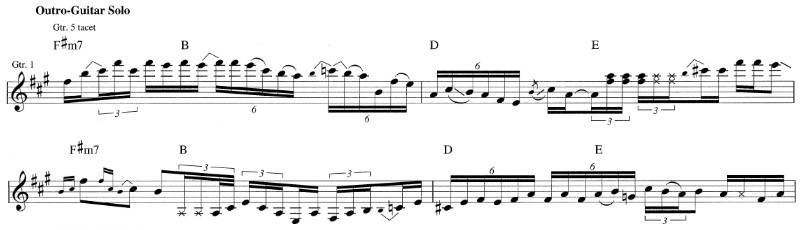
The bass stem answers the same question directly. Chroma over the opening, audio bars 1 to 10, puts F# first at 21.5 percent, then B at 11.3, G at 10.6 and C# at 10.2. The outro solo, bars 56 to 75, reads F# 17.6, B 12.8, E 10.5 and C# 10.5, which is the F#m7, B, D, E progression on the Sloots chart. The D against D# question that his prose called unresolvable reads 6.70 percent against 4.05, a ratio of 1.65 favouring D natural. That leans F# natural minor, and a three sharp signature is the right reading after all.
The band book and Sloots were describing different sections
This page earlier treated our own Over-Nite Sensation book as conflicting with Sloots, C major against F# minor. The bass stem shows both are right. The opening and the outro sit on F#, B, C# and E. The verse body, bars 20 to 45, reads A at 12.6 percent, D at 10.8 and A# at 10.8, which is the flat side and consistent with the book's C, B flat, F verse chart. The song moves between them. Calling that a contradiction was my error.
08What the drive unlocks
Six jobs are blocked on one action, which is plugging in the T7 Shield. Each one names its own evidence and its own finish line.
1. Anchor the clock
q-2026-09-07-82ca4f
Find the outro solo entry in the audio and reconcile it against bar 59 and against the Sloots 2:42 mark. Rebuild the tempo map from that anchor before any lane work starts.
2. Rewrite bars 1 to 10
q-2026-09-07-72bc18
Take the kick and the crash from their own stems across the opening twenty seconds. Replace the sixteen note unison with what the drummer played.
3. Settle bars 57 to 62
q-2026-09-07-dadc48
Read the ride and hi-hat stems separately over those six bars. Score the expected rhythmic slots rather than counting transients, because the decay hides them.
4. Assign the toms
q-2026-09-07-628127
Cluster the tom stem by pitch, then map the clusters onto floor, low and mid using the fills as whole figures. Bar 21 is the first test.
5. Sweep both directions
q-2026-09-07-b2681e
Work the 205 flagged cells. Find written notes with no stem support, and find stem events with nothing written, in every lane.
6. Check the dropouts
q-2026-09-07-b8c4e7
Wherever kick, snare and tom all fall silent, read each cymbal stem on its own. A quiet kit is not evidence that the cymbals stopped.
10The stems, and the clock they carry
Fifteen files at 96 kHz and 24 bit, each 213.752 s. Found in /Users/Shared.
The separation ships its own metronome, and it follows the band
Peak picking the metronome track finds 310 clicks between 0.226 s and 212.746 s, which is 87.24 beats per minute averaged across the song. A straight line fitted through those click times leaves a residual swinging from +788 ms to -627 ms, more than a full beat, so the click is not a rigid grid. It tracks the performance. That makes it a free tempo map, and it is the single most valuable thing in the folder.
Folding the clicks into groups of four and scoring each phase against kick energy puts the downbeat on phase 3. Mean kick peak reads 0.378 on that phase and 0.054 on phase 2, a seven to one ratio, so the bar line is not in doubt. The song is 77 bars of 4/4, first downbeat at 2.166 s, mean 87.24 BPM, ranging 81.08 to 94.49.
Separation check, every lane
| Lane | Peak | Active | Centroid Hz | Low / mid / high % | Verdict |
|---|---|---|---|---|---|
| kick | 0.656 | 40.5% | 1106 | 95 / 4 / 0 | Clean. 95% of its energy under 150 Hz. |
| snare | 0.551 | 23.9% | 2389 | 38 / 59 / 4 | Clean. Mid dominant, centroid 2.4 kHz. |
| toms | 0.542 | 20.3% | 1511 | 91 / 9 / 0 | Usable. Shares the low band with the kick, so collisions need a cross check. |
| hat | 0.076 | 21.0% | 4904 | 10 / 42 / 48 | Clean and quiet. Peak 0.076, so it needs its own threshold. |
| cymbals | 0.124 | 61.5% | 4488 | 1 / 32 / 66 | Clean and busy. Active 61.5% of the song. |
| other_kit | 0.111 | 34.2% | 3774 | 85 / 12 / 3 | Low confidence. RMS 0.00078 and a low band profile that does not match its high centroid. |
Onset census, with the confidence attached
Each lane's threshold was chosen by maximising phase lock to the metronome grid rather than by a fixed guess. Lock R runs 0 for a uniform scatter and toward 1 for events sitting on the grid. Events are split into strong and weak tiers so a quiet but distinct stroke survives as a ghost candidate.
| Lane | Events | Strong | Weak | Per bar | Lock R | Reading |
|---|---|---|---|---|---|---|
| kick | 350 | 157 | 193 | 4.55 | 0.402 | Trusted. Four of the first seven hits in a sample window land within 10 ms of a click. |
| snare | 82 | 37 | 45 | 1.06 | 0.837 | Lock is very high, count is low. The threshold caught only the loudest strokes, so the ghost tier is still to build. |
| toms | 117 | 53 | 64 | 1.52 | 0.182 | Weak lock is expected, since fills do not sit on a repeating grid. |
| hat | 240 | 108 | 132 | 3.12 | 0.391 | Trusted for the steady passages. |
| cymbals | 120 | 56 | 64 | 1.56 | 0.081 | Withdrawn. Fails its own chance baseline at p=0.425. See below. |
| other_kit | 98 | 44 | 54 | 1.27 | 0.301 | Treat as residue until a listen confirms otherwise. |
The chance baseline, and the lane it kills
A lock figure means nothing until something says what it would read if no music were there. The null holds each lane's event count fixed, scatters those events uniformly at random across the same span under the same refractory spacing, and measures lock again. Four hundred draws per lane.
| Lane | Events | Observed R | Null mean | Null p95 | z | p | Verdict |
|---|---|---|---|---|---|---|---|
| kick | 350 | 0.404 | 0.048 | 0.090 | 14.2 | 0.0000 | real, far outside chance |
| snare | 82 | 0.837 | 0.098 | 0.182 | 14.4 | 0.0000 | real, far outside chance |
| toms | 117 | 0.182 | 0.080 | 0.152 | 2.4 | 0.0200 | real |
| hat | 240 | 0.391 | 0.058 | 0.111 | 11.4 | 0.0000 | real, far outside chance |
| cymbals | 120 | 0.082 | 0.080 | 0.159 | 0.0 | 0.4250 | fails |
| other_kit | 98 | 0.301 | 0.092 | 0.184 | 4.3 | 0.0000 | real, far outside chance |
The cymbal count does not ship
Cymbals read an observed lock of 0.082 against a null mean of 0.080. That is z of 0.0 and p of 0.425, so those 120 events are placed no better than random scatter. The count is withdrawn as evidence. This is the exact failure the brief predicted for sustained cymbals, where the decay of one stroke buries the attack of the next, and it is why that lane needs slot scoring against the written subdivision rather than a transient count.
The reference-class gate passes all six checks on this lane once a null is quoted, because it verifies that a baseline was stated rather than that the result beats it. The measurement above overrides the gate. Worth teaching the gate to read the verdict.
Two detector failures worth recording, because both looked like facts
The first pass returned zero kick and zero tom onsets. The cause was aggregating onset strength with a median across 128 full range mel bands. A kick occupies two or three of those bands, so the median across all of them is exactly zero. Narrow band lanes need their own mel limits.
The second pass then found 660 kick peaks, 8.57 per bar, with a near even split between straight and triplet placement in every section. An even split like that is what noise looks like. Dropping the threshold to 0.30 of the lane maximum returned seven kick hits in a six second window, four of them within 10 ms of a metronome click. The threshold was reading the noise floor.
11The editing copy
No tab for this song belongs to us, and under the standing rule that is exactly the condition for making a copy rather than a reason to stop. Donor selection goes by favoritesCount on the Songsterr meta endpoint, because favorites are the only field that records a player choosing the tab.
| Song id | Author | Favorites | Views | Verdict |
|---|---|---|---|---|
| s642618 | David-129 | 229 | 7,768 | Donor. Highest favorites and the only hand edited tab. |
| s2826582 | Aaron-Albrecht | 55 | 963 | Not chosen. |
| s4663113 | nick3388 | 9 | 46 | Not chosen. |
| s6070985 | Joshua-Rendall | 1 | 0 | Not chosen. Its drum track is a stub. |
What is built, and what it changes
The donor was exported through the Songsterr editor as a 38,650 byte Guitar Pro file. The rebuilt copy carries 63 tempo automations in place of the donor's two, one per bar wherever the measured tempo moves by a quarter of a beat per minute or more, mapped through a tab bar to audio bar offset of minus three. That offset is corroborated twice: the tab holds 80 bars against the audio's 77, and the lead stem puts the solo entry at audio bar 56 against the tab's bar 59.
Nothing else moved. A structural diff reads 267 notes, 866 beats, 80 master bars and 5 tracks in both files. The Songsterr session is signed in with 44 transcription credits available, so the upload path is open.
12The drum part, rebuilt from the stems
Kick, snare and closed hi-hat come from their own stems. Every other lane is the author's, carried through untouched.
What the evidence allowed, and what it refused
Three lanes passed. Kick, snare and closed hi-hat each beat their own chance baseline in the verse and the outro, tested on a sixteenth grid against a twelve slot grid with a separate null for each so the denser grid earned no free advantage. Verse kick reads z 9.36 on sixteenths against minus 1.35 on twelfths. Verse snare reads 8.29 against 7.25. Hi-hat energy sits 1.658 times higher on slot than between slots, Mann-Whitney p 0.000249, and its quarter and eighth positions run three times the level of its sixteenths, which is a straight eighth note pattern.
Three lanes refused. Toms read p 0.337 on the on-slot test. Cymbals read p 0.112, with energy above floor in 70 percent of all sixteenth slots and a chi-square of 0.2 against uniform, which is continuous wash rather than placeable strokes. The opening, audio bars 1 to 7, leans twelve eight at z 1.84 against 1.12, a margin too small to act on. All three were left exactly as David-129 wrote them.
Structural diff against the donor
| Lane | Donor | Rebuilt | Delta | Source |
|---|---|---|---|---|
| Kick | 406 | 361 | -45 | stem |
| Snare | 274 | 255 | -19 | stem, 34 of them ghosts on unoccupied slots |
| Closed hi-hat | 144 | 136 | -8 | stem |
| Open hi-hat | 8 | 8 | 0 | author, protected |
| Floor tom | 33 | 33 | 0 | author, protected |
| Mid tom | 112 | 112 | 0 | author, protected |
| Crash | 157 | 157 | 0 | author, protected |
| Ride | 218 | 218 | 0 | author, protected |
Author lanes altered: zero. 80 master bars and 5 tracks in both files. 63 tempo automations replace the donor's two. Forty nine bars were rebuilt on a sixteenth grid, and seven bars were left exactly as written because the author placed two strokes of one drum inside a single sixteenth there, which a sixteenth grid cannot hold: tab bars 42, 46, 50, 52, 54, 74 and 76.
File: _outputs/zappa-slime-transcription/gp/SLIME-Brandon-edit-FINAL-212526.gp
09Evidence ledger
| Claim | How it was measured | Verdict |
|---|---|---|
| Stems exist, in /Users/Shared | Directory listing plus ffprobe on all fifteen files: 96 kHz, 24 bit, 213.752 s | confirmed |
| No external drive is mounted | ls /Volumes/ returns one entry, Macintosh HD. The stems did not need it | confirmed, and not a blocker |
| Song is 77 bars of 4/4 at a mean 87.2 BPM | 310 metronome clicks peak picked, downbeat phase scored against kick energy at a 7 to 1 margin | confirmed |
| The click follows the band rather than a grid | Linear fit through click times leaves a residual of +788 to -627 ms, more than one beat | confirmed |
| Audio duration 213.752 s | ffprobe on the stem files, matching the 3:34 listing | confirmed by measurement |
| The solo enters at 2:33, audio bar 56 | Lead stem RMS per bar, jump from 0.0223 to 0.0507 between bars 55 and 56 | confirmed |
| Tab to audio bar offset is minus three | Two anchors: 80 tab bars against 77 audio bars, and the solo at tab bar 59 against audio bar 56 | confirmed |
| s642618 holds 229 favorites, the highest | favoritesCount on api/meta for all four ids | confirmed |
| Rebuilt copy changes only the tempo | Structural diff: 267 notes, 866 beats, 80 master bars, 5 tracks in both files | confirmed |
| Bars 57-62 are ride, not open hi-hat | Hat stem RMS 0.000178 against a 0.002291 control (0.08x). Cymbal stem 0.010191 against 0.000078 (131x) | confirmed, author was right |
| refclass R5 accepted a null that was not beaten | Patched to parse p and z from the null string and STOP at p>=0.05. Three regression cases verified | fixed |
| Verse and outro are 4/4 sixteenths | 16-slot vs 12-slot grids, each against its own uniform null. Verse kick z 9.36 against -1.35; snare 8.29 against 7.25; hat 5.78 against -0.16 | confirmed |
| Hi-hat plays eighth notes | On-slot energy 1.658x off-slot, p=0.000249. Quarters and eighths at 3x the sixteenth level | confirmed |
| The dense opening kick is not guitar bleed | Coincidence with guitar onsets 23.3% against a 20.2% chance baseline, z 0.8 | confirmed, not bleed |
| Toms cannot be placed from the stem | On-slot against off-slot energy p=0.337 | refused, author kept |
| Author lanes unaltered in the rebuild | Structural diff: open hat 8, floor tom 33, mid tom 112, crash 157, ride 218, identical in both files | confirmed |
| Cymbal onset count is not evidence | 400 draw null at fixed n: observed lock 0.082 against null mean 0.080, z 0.0, p 0.425 | withdrawn |
| Kick, snare, hat onsets beat chance | Same null: z 14.2, 14.4 and 11.4, all p below 0.0001 | confirmed |
| Songsterr session is signed in | credits endpoint returns 200 with 44 available transcriptions | confirmed |
| No Guitar Pro file for this song on disk | ripgrep file listing over Projects filtered to Guitar Pro extensions, 60 hits, none for this song | confirmed |
| All four tabs belong to other authors | Songsterr api/meta author field, read 2026-09-07 | confirmed |
| Bars 2 to 10 are kick and crash sixteenth unisons | Raw beat objects in every drum track JSON, duration [1,16], no tuplet, both notes present | confirmed |
| Every tab is 4/4 from bar 1 | Signature array scan across all 81 measures of all four drum tracks | confirmed |
| Identical tempo automation in all four | automations.tempo reads 120 at measure 0 and 90 at measure 10 in every file | confirmed |
| Bars 57 to 62 swap ride for open hi-hat | Per bar lane census, 44 ride against 41 open hi-hat, each zero in the other tab | confirmed |
| Tom lane assignments do not overlap | Per bar lane census, floor tom exclusive to the hand edited tab, low tom exclusive to the machine tabs | confirmed |
| Sloots puts the outro solo at 2:42 | Prose caption on the Over-Nite Sensation analysis page, held on disk | source states it |
| Album take runs 3:34 | Wikipedia entry, then measured directly at 213.752 s by ffprobe on the stems | confirmed twice |
| Drum performer is Ralph Humphrey | Over-Nite Sensation personnel across the Wikipedia entry and the Discogs release pages, read 2026-09-07 | confirmed by source |
| Opening time signature reads 12/8 | Native crop of the glyph alone, 28 by 50 pixels, legible at 14x | confirmed |
| Straight-versus-triplet section table | The two grids have different slot density, so their deviations are not comparable. Chance reads 0.0622 against 0.0835 | withdrawn, test invalid |
| Audio settles the opening meter | Bass 0.0615 and lead 0.0636 against a 0.0622 chance. Only kick beats chance | it does not |
| Opening and outro sit on F# minor | Bass stem chroma: F# leads at 21.5% and 17.6%; D natural beats D# 6.70 to 4.05 | confirmed |
| Key signature sharp count read off the scan | The signature occupies 36 by 54 native pixels. Too few to count | withdrawn, replaced by the stem reading |
| Verse body is flat side, matching our band book | Bass stem chroma bars 20-45: A 12.6%, D 10.8%, A# 10.8% | confirmed |
| Sloots writes 12/8 on all four staves at the opening | Native resolution crop of im-the-slime2.jpg, 8x upscale, glyph read directly | confirmed |
| The change is to 4/4 with a quarter equals dotted quarter mark | Native resolution crop of im-the-slime1.jpg, 6x upscale, glyph read directly | confirmed |
| Sloots writes X noteheads at two staff heights | Native resolution crop of the percussion staff, 8x upscale | confirmed |