Watermelon In Easter Hay, the chart's toms written into the tab
Frank Zappa, Joe's Garage Act III. Songsterr s35881, drum track, Vinnie Colaiuta. Source is the Drumnet.ru drumset chart by BartoRomeo. Built 2026-09-08.
What was asked, and what the file now holds
The ask was to add the chart's tom locations to the Watermelon GP file, with the legend given directly: the toms are the G, the D, and the F above the F, and anything carrying an x notehead gets skipped.
The tab carried six tom notes at the start of this pass, four Low Tom and two High Tom, and all six sit inside the 96 bars the chart transcribes. The chart carries 179 filled tom noteheads over those same bars that the tab never received. All 179 are now in the file, at the bar and beat the transcriber drew them.
The legend, and how the staff maps to the kit
The chart is a five-line drumset staff. Numbering the positions from the top line down, 0 for the top line and 8 for the bottom, the note letters read in the treble names a drummer uses: E on the bottom line, F, G, A, B, C, D, E, F on the top line.
The Guitar Pro file already agrees with that reading. Its own drum kit definition stores a StaffLine for every articulation, and the numbers are the same scale: Snare sits at 3, Ride at 0, High Tom at 2 and Very Low Tom at 6. So two of the three tom positions carry straight across with no interpretation at all.
| Chart position | Lane | Filled heads | GP articulation | MIDI | StaffLine | Fit |
|---|---|---|---|---|---|---|
| the F above the F, top line | 0 | 35 | High Floor Tom (hit) | 50 | 1 | one position lower |
| the D, fourth line | 2 | 98 | High Tom (hit) | 48 | 2 | exact |
| the G, second line | 6 | 46 | Very Low Tom (hit) | 43 | 6 | exact |
Skip anything with an x on it
The top line carries two instruments at once: the ride, drawn with x noteheads, and a tom, drawn with filled ovals. Reading the top line naively would import the whole ride part as toms.
The two separate on ink. Measuring the mean darkness of a five by five pixel box centred on each head, an x leaves its four edge midpoints on white paper and a filled oval does not. On the top line, where the decision actually has to be made, the two populations do not touch:
| Population | Count | Ink, mean of a 5×5 box | Reading |
|---|---|---|---|
| x noteheads, top line | 57 | 104 to 127 | ride, skipped |
| watermark letters and noise, top line | 18 | 131 to 158 | not notation, skipped |
| nothing at all, top line | 0 | 159 to 185 | the empty gap that makes the cut safe |
| filled tom heads, all three lanes | 179 | 186 to 220 | kept |
| snare, a filled control | 154 | median 220 | control |
| kick, a filled control | 410 | median 201 | control |
| Both counts are chart heads over the chart's own 96 bars. The tab holds 177 snare and 99 kick across those same bars. | |||
Across all three tom lanes the same cut skips 64 x-like marks, 33 watermark fragments and 4 more in the 160 to 180 band, and keeps 179.
Which bar each tom belongs to
The chart runs 96 bars and the tab runs 105, so the two had to be tied together first, since a wrong offset writes every note into a wrong bar. Chart display bar n is GP display bar n plus 9.
That offset is not a guess. The chart carries nine rehearsal marks and the tab carries eleven named sections, and every one of the chart's nine lands on a named section at the same offset, including a solo that runs exactly 24 bars in both:
| Chart bar | Chart mark | GP bar | GP section | Offset |
|---|---|---|---|---|
| 1 | A | 10 | Head 1 | +9 |
| 17 | B | 26 | Bridge 1 | +9 |
| 25 | A | 34 | Head 3 | +9 |
| 33 | Solo I | 42 | Solo | +9 |
| 57 | A | 66 | Head 4 | +9 |
| 65 | A | 74 | Head 5 | +9 |
| 73 | B | 82 | Bridge 2 | +9 |
| 81 | A | 90 | Head 6 | +9 |
| 89 | Coda | 98 | Outro | +9 |
Two more facts agree with it. The 96 chart bars fill GP display bars 10 through 105 exactly, with none left over at either end. And the meters line up throughout, since the chart alternates 4/4 and 5/4 and so does the tab from its second bar onward.
Where in the bar
Inside one bar this engraving is close to linear in time. On page 1 system 1 the filled heads sit at 79.3, 128.3, 164.8, 176.8, 225.9 and onward, whose smallest gap is 11.9 pixels and whose other gaps are 24.4, 36.4 and 48.8. That is one sixteenth note per 12.2 pixels, and sixteen of them land on the bar's own closing barline.
So each bar was fitted with a single free parameter, the x of its downbeat, with the sixteenth width forced to (x_end − x0) / nsub. Across all 96 bars the fitted width came out at a median of 12.22 pixels, from 11.43 to 13.46.
| Measure | Value | Meaning |
|---|---|---|
| Bars fitted | 96 of 96 | no bar dropped |
| Median position error | 0.10 of a sixteenth | about 1.2 pixels, the centroid noise floor |
| 90th percentile | 0.21 | |
| Worst single note | 0.28 | inside a sixty-fourth |
| Written as sixteenths | 135 | |
| Written as thirty-seconds | 35 | |
| Sitting on a sixteenth triplet | 9 | placed on a sixty-fourth grid, 1/12 of a sixteenth away |
Bar by bar, the chart against the tab
Three pictures per bar: the printed chart, the tab as it stood, and the tab carrying the chart's toms. The added voice draws in grey, so everything black is untouched original.
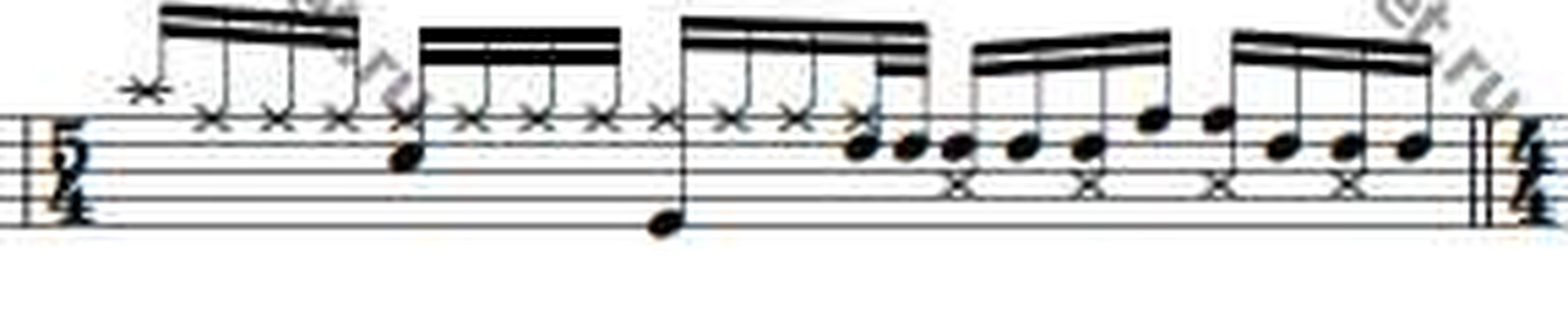


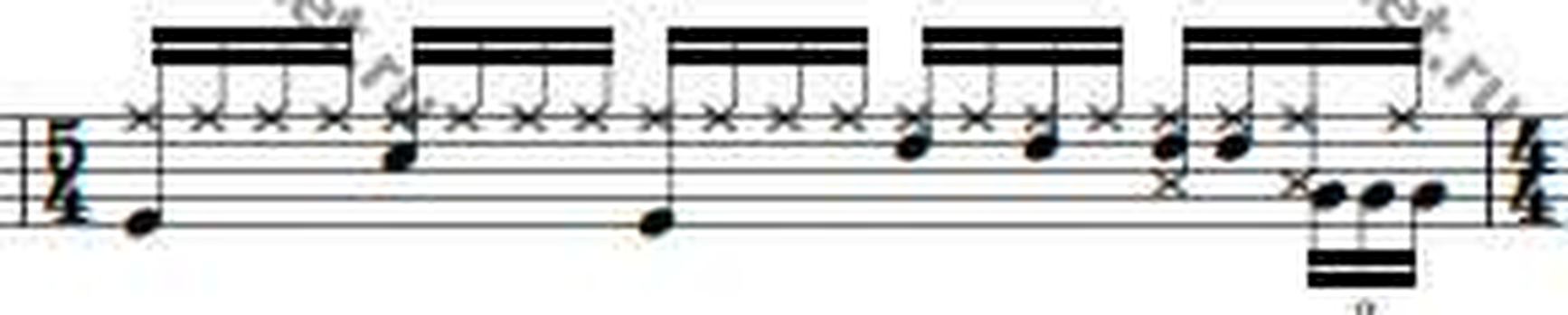


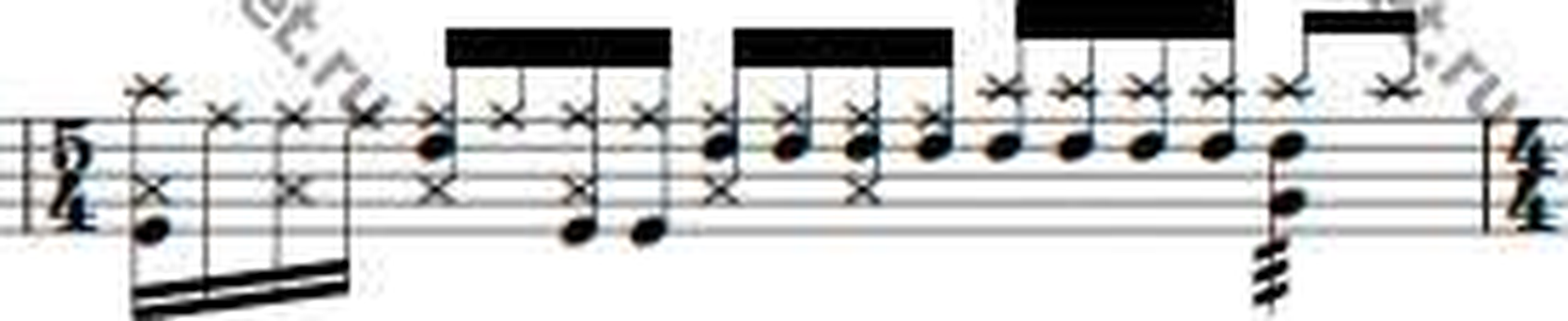


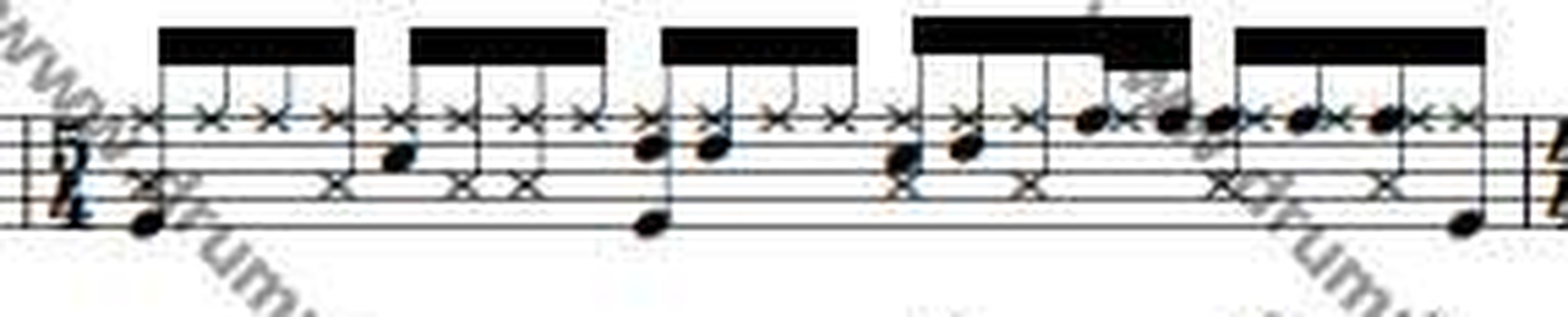


All 179, by bar
Positions are counted in sixteenth notes from the downbeat, so 0 is beat 1 and 4 is beat 2. A 4/4 bar runs 0 to 15 and a 5/4 bar runs 0 to 19.
| GP bar | Chart bar | Toms | F above the F | D | G |
|---|
How the reading was made, and where each method stopped
Finding every system on the page
Two earlier detectors under-counted and both failed the same way. A staff line spans about 97 percent of the staff width, so counting pixels darker than a fixed threshold looks safe. That rule fails here, since this scan darkens unevenly down the page, and on page 1 the line at row 280 sits at grey 112 while the line at row 353 sits at 176. A threshold of 150 sees the first and misses the second, which lost two systems on page 1 and three on page 5.
The row median does not care what the grey happens to be, because the line covers more than half the row. Under that rule the page yields 48 systems with perfectly regular gaps, 8 then 11, 11, 11 and 7, which is 96 bars at two per system, and every printed bar number on all five pages agrees.
Finding the barlines
Full staff height of ink alone returns 9 to 28 candidates per system where 3 exist, because a stem running from a low notehead up to its beam covers the staff too. What separates them is the poke-out: a barline stops at the staff and a stem continues into its beam. One system on page 4 has a beam passing over its middle double bar, so there the test relaxes to nothing below the staff, and the middle bar is then chosen by the 16 to 20 sixteenth proportion the two bars must share.
What is still uncertain
- Both comparisons below run over the chart's own 96 bars only, GP display 10 through 105. The tab's headline totals of 193 snare and 107 kick cover 105 bars, nine of which the chart never transcribes, and those nine hold 16 snare and 8 kick. The 6-against-179 tom comparison needs no such restriction, since all six of the tab's toms already sit inside the chart's span and the nine bars outside it hold none.
- The scan is 595 by 842 pixels and a notehead is 4 to 5 pixels across, so the snare reads 154 heads against the tab's 177 over the same bars. The reader misses some heads in the busiest bars. Every miss is a tom the tab still lacks, never a tom invented.
- The chart writes 410 kicks against the tab's 99 over the same bars. That gap was measured in passing and is not touched by this build, which adds toms and nothing else.
- A rescan at 12 or more pixels per notehead would settle both. Every method above already works and would simply get more of the page.
Verification
The toms went into voice slot 1, which was empty on all 105 drum bars. Nothing was displaced, and deleting that voice returns the file to its exact starting state.
A second reading of the same chart, uploaded in parallel
While this build was running, another session read the same Drumnet pages and published its result to the copy tab s6857183, "Watermelon In Easter Hay Brandon edit". Revision 8968036 landed at 17:17 UTC and 8968524 at 17:43. Quoting that revision's own note, not this build: the chart supplied the tom count and the drum, Moises stems supplied the timing, its tom total is 164, with 34 held back where the stem did not carry the chart's count. The total for this build is 179, and that is the number behind every figure on this page.
What the two agree on
32 of the 48 tom-carrying bars hold identical per-drum counts in both reads, and the G lane totals 46 in each. Two pipelines that share nothing but the printed page landed on the same answer across two thirds of the music.
Where they differ, and what the page shows
| GP bar | This build | Live tab | What the chart shows at 9× |
|---|---|---|---|
| 25 | 10 | 3 | a run of ten filled ovals fills the second half of chart bar 16, eight on the D and two a position higher |
| 15 | 3 | 6 | three solid ovals in chart bar 6, one on the top line and two on the D, none on the G |
| 95, 97, 99, 100, 101, 103, 104 | 19 | 0 | the Coda, marked p, pp and "cymbal on dome", is where a stem gate is least able to hear a soft tom |
| 14, 93 | 0 | 6 | not yet inspected |
Scope record for the counts, as the governing skill asks for
The revised perfect_stem_read_skill_WATERMELON_REVISED.md verifies on this Mac: SHA256 94276444…84e1b1, 287 lines, 7,767 words, all three exact. Its line 155 requires every published comparison count to carry an explicit scope record, and its line 273 names the Watermelon snare figures specifically. This is that record.
The snare pair, reconciled
| Field | Value |
|---|---|
| Chart artifact | Drumnet.ru, Watermelon In A Easter Hay, BartoRomeo, 5 pages, 595×842 px |
| Tab artifact | RESTORED-s35881-TEXTSAFE-v2.gp, from s35881 revision 8908034 |
| Measure range | the chart's own 96 bars, GP display 10 through 105 |
| Tracks and voices | track 8 only, voice 0 only |
| Event definition | chart side, visible filled noteheads on lane 3; tab side, Guitar Pro note objects with midi 40 |
| Ghost and grace policy | ghosts counted, no grace strokes present on the snare lane |
| Reader version | chart_heads_full.py with the ink cut at 180, systems from systems_median.py |
| Reconciled pair | 154 chart heads against 177 tab snares |
| Why 193 differs | 193 counts all 105 tab bars; the nine the chart never transcribes hold 16 snare |
| Where 340 comes from | r8968036's snare total over all 105 bars; r8968524 holds 342 |
Two figures worth a second look
| Item | Document | Measured here | Measured on the live payloads |
|---|---|---|---|
| Sub-sixteenth tom positions | 41 | 44 | 51 in r8968036, 49 in r8968524 |
| Drummer named at line 271 | Bozzio | Vinnie Colaiuta. The Guitar Pro file names track 8 "Vinnie Colaiuta", and Joe's Garage is his date. Bozzio played the earlier Zappa records. | |
Events and distinct positions come out equal in all three reads, so the 41 gap is not an events-against-positions difference.
Where the document corrects this read, and it is right
Line 271 calls the three-tom ceiling a reader-representation defect, and line 105 says a chart showing three visible tom lanes cannot cap the audio reader at three physical drums. That lands: every one of the 179 events here was assigned to just three MIDI values because the chart draws three lanes, and the kit exposes six. Line 271 also says the chart's lane names cannot be recycled into a stem classifier as independent evidence, which is the same circularity the staff guard flagged.